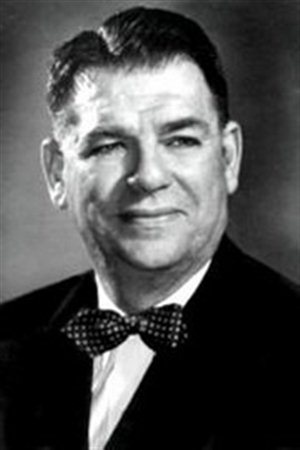
Oscar Hammerstein II
Biography
Oscar Greeley Clendenning Hammerstein II (b. July 12, 1895 – d. August 23, 1960) was an American librettist, theatrical producer, and theatre director of musicals for almost forty years. Hammerstein won eight Tony Awards and was twice awarded an Academy Award for "Best Original Song". Many of his songs are standard repertoire for singers and jazz musicians. He co-wrote 850 songs. Hammerstein was the lyricist and playwright in his partnerships; his collaborators wrote the music. Hammerstein collaborated with composers Jerome Kern, Vincent Youmans, Rudolf Friml and Sigmund Romberg, but his most famous collaboration was with Richard Rodgers. Early life Hammerstein was born Oscar Greeley Clendenning Hammerstein in New York City, the son of Alice (née Nimmo) and William Hammerstein. His grandfather was German-born Jewish theater impresario Oscar Hammerstein I, and his mother was the daughter of Scottish and English parents. Hammerstein was raised an Episcopalian. Although Hammerstein's father managed the Victoria Theatre for Oscar Hammerstein I and was a producer of vaudeville shows (he is generally credited with inventing the "pie-in-the-face" routine), he was opposed to his son's desire to participate in the arts. Hammerstein attended Columbia University from 1912–1916 and studied at Columbia Law School until 1917. It was not until his father's death on June 10, 1914, that he participated in his first play with the Varsity Show, entitled On Your Way. Throughout the rest of his college career, Hammerstein wrote and performed in several Varsity Shows. Early career After quitting law school to pursue theatre, Hammerstein began his first professional collaboration, with Herbert Stothart, Otto Harbach and Frank Mandel. He began as an apprentice and went on to form a 20-year collaboration with Harbach. Out of this collaboration came his first musical, Always You, for which he wrote the book and lyrics. It opened on Broadway in 1921. Throughout the next forty years, Hammerstein teamed with many other composers, including Jerome Kern, with whom Hammerstein enjoyed a highly successful collaboration. In 1927, Kern and Hammerstein had their biggest hit, Show Boat, which is often revived and is still considered one of the masterpieces of the American musical theatre. Other Kern-Hammerstein musicals include Sweet Adeline, Music In the Air, Three Sisters, and Very Warm for May. Hammerstein also collaborated with Vincent Youmans (Wildflower), Rudolf Friml (Rose-Marie), and Sigmund Romberg (The Desert Song and The New Moon). Rodgers and Hammerstein Hammerstein's most successful and sustained collaboration began when he teamed up with Richard Rodgers to write a musical adaptation of the play Green Grow the Lilacs. Rodgers' first partner, Lorenz Hart, originally planned to collaborate with Rodgers on this piece, but his alcoholism had become out of control, and he was unable to write. Hart was also not certain that the idea had much merit, and the two therefore separated. The adaptation became the first Rodgers and Hammerstein collaboration, entitled Oklahoma!, which opened on Broadway in 1943. It furthered the revolution begun by Show Boat, by thoroughly integrating all the aspects of musical theatre, with the songs and dances arising out of and further developing the plot and characters. After Oklahoma!, Rodgers and Hammerstein were the most important contributors to the musical-play form – with such masterworks as Carousel, The King and I and South Pacific. The examples they set in creating vital plays, often rich with social thought, provided the necessary encouragement for other gifted writers to create musical plays of their own". The partnership went on to produce these and other Broadway musicals such as Allegro, Me & Juliet, Pipe Dream, Flower Drum Song, and The Sound of Music, as well as the musical film State Fair (and its stage adaptation of the same name), and the television musical Cinderella, all featured in the revue A Grand Night for Singing. Hammerstein also wrote the book and lyrics for Carmen Jones, an adaptation of Georges Bizet's opera Carmen with an all-black cast that became a 1943 Broadway musical and a 1954 film. Death Hammerstein died of stomach cancer at his home in Doylestown, Pennsylvania, at 65, shortly after the opening of The Sound of Music on Broadway. The final song he wrote was "Edelweiss", which was added during rehearsals near the end of the second act. This was not an Austrian folk song, but had been written specifically for the musical. After his death, The Sound of Music was made into the hit 1965 film adaptation, which won the Academy Award for Best Picture. The lights of Times Squarewere turned off for one minute, and London's West End lights were dimmed in recognition of his contribution to the musical. He was cremated, and his ashes were buried at the Ferncliff Cemetery in Hartsdale, New York. A memorial plaque was unveiled at Southwark Cathedral, England, on May 24, 1961. He was survived by his second wife Dorothy (Blanchard) Jacobson (m. May 13, 1929) and his three children, William Hammerstein and Alice Hammerstein Mathias by first wife Myra Finn, and James Hammerstein by Blanchard. Dorothy, b. June 7, 1899, died Aug. 3, 1987 in New York. Songs Hammerstein contributed the lyrics to 850 songs, according to The Complete Lyrics of Oscar Hammerstein II, edited by Amy Asch. Some well-known songs are "Ol' Man River", "Can't Help Lovin' That Man" and "Make Believe" from Show Boat; "Indian Love Call" from Rose-Marie; "People Will Say We're in Love" and "Oklahoma" from Oklahoma!; "Some Enchanted Evening", from South Pacific; "Getting to Know You" and Shall We Dance from The King and I; and the title song as well as "Climb Ev'ry Mountain" from The Sound of Music. Several albums of Hammerstein's musicals were named to the "Songs of the Century" list as compiled by the Recording Industry Association of America (RIAA), the National Endowment for the Arts, and Scholastic Corporation: The Sound of Music — # 36 Oklahoma! — # 66 South Pacific — # 224 The King and I — # 249 Show Boat — # 312 [edit]Awards and legacy Hammerstein won two Oscars for best original song—in 1941 for "The Last Time I Saw Paris" in the film Lady Be Good, and in 1945 for "It Might as Well Be Spring" in State Fair. In 1950, the team of Rodgers and Hammerstein received The Hundred Year Association of New York's Gold Medal Award "in recognition of outstanding contributions to the City of New York." Hammerstein won eight Tony Awards, six for lyrics or book, and two as producer of the Best Musical (South Pacific and The Sound of Music). Rodgers and Hammerstein began writing together before the era of the Tonys: Oklahoma! opened in 1943 and Carousel in 1945, and the Tony Awards were not awarded until 1947. Rodgers and Hammerstein received a special Pulitzer Prize for Oklahoma! in 1944. The Oscar Hammerstein II Center for Theater Studies at Columbia University was established in 1981 with a $1-million gift from his family. His advice and work influenced Stephen Sondheim, a friend of the Hammerstein family from childhood. Sondheim has attributed his success in theater directly to Hammerstein's influence and guidance