Louis Kahn
Biography
Early life Louis Kahn, whose original name was Itze-Leib (Leiser-Itze) Schmuilowsky (Schmalowski), was born in Kuressaare on the Estonian island of Saaremaa, then part of the Russian Empire. His actual birth year may have been inaccurately recorded when, in 1906, his Jewish family immigrated to the United States, fearing that his father would be recalled into the military during the Russo-Japanese War. Perhaps because of this fear, the family moved seventeen times. As the scarred child of Estonian immigrant Jews, he grew up poor in Philadelphia. According to his son's documentary film in 2003[1] the family couldn't afford pencils but made their own charcoal sticks from burnt twigs so that Louis could earn a little money from drawings and later by playing piano to accompany silent movies. He became a naturalized citizen on May 15, 1914. His father changed their name in 1915. [edit] Career He trained in a rigorous Beaux-Arts tradition, with its emphasis on drawing, at the University of Pennsylvania. After completing his Bachelor of Architecture in 1924, Kahn worked as senior draftsman in the office of City Architect John Molitor. In this capacity, he worked on the design for the 1926 Sesquicentennial Exposition.[2] In 1928, Kahn made a European tour and took a particular interest in the medieval walled city of Carcassonne, France and the castles of Scotland rather than any of the strongholds of classicism or modernism.[3] After returning to the States in 1929, Kahn worked in the offices of Paul Philippe Cret, his former studio critic at Penn, and in the offices of Zantzinger, Borie & Medary in Philadelphia.[4] In 1932, Kahn and Dominique Berninger founded the Architectural Research Group, whose members were interested in the populist social agenda and new aesthetics of the European avant-gardes. Among the projects Kahn worked on during this collaboration are unbuilt schemes for public housing that had originally been presented to the Public Works Administration.[5] Among the more important of Kahn's early collaborations was with George Howe.[6] Kahn worked with Howe in late 1930s on projects for the Philadelphia Housing Authority and again in 1940, along with German born architect Oscar Stonorov for the design of housing developments in other parts of Pennsylvania.[7] Louis I. Kahn did not find his distinctive architectural style until he was in his fifties. Initially working in a fairly orthodox version of the International Style, a stay at the American Academy in Rome in the early 1950s marked a turning point in Kahn's career. The back-to-the-basics approach he adopted after visiting the ruins of ancient buildings in Italy, Greece and Egypt helped him to develop his own style of architecture influenced by earlier modern movements but not limited by their sometimes dogmatic ideologies. In 1961 he received a grant from the Graham Foundation to study traffic movement[8][9] in Philadelphia and create a proposal for a viaduct system. He describes this proposal at a lecture given in 1962 at the International Design Conference in Aspen, Colorado: In the center of town the streets should become buildings. This should be interplayed with a sense of movement which does not tax local streets for non-local traffic. There should be a system of viaducts which encase an area which can reclaim the local streets for their own use, and it should be made so this viaduct has a ground floor of shops and usable area. A model which I did for the Graham Foundation recently, and which I presented to Mr. Entenza, showed the scheme.[10] Kahn's teachng career started at Yale in 1947 and he was eventually named Albert F. Bemis Professor of Architecture and Planning at MIT in 1962 and Paul Philippe Cret Professor of Architecture at the University of Pennsylvania in 1966 and was also a Visiting Lecturer at Princeton University from 1961 to 1967. Kahn was elected a Fellow in the American Institute of Architects (AIA) in 1953. He was made a member of the National Institute of Arts and Letters in 1964, He was made a member of the American Academy of Arts and Sciences in 1968 and awarded the AIA Gold Medal, the highest award given by the AIA, in 1971[11] and the Royal Gold Medal by the RIBA in 1972. [edit] Personal life Kahn had three different families with three different women: his wife, Esther who he married in 1930; Anne Tyng, who began her working collaboration and personal relationship with Kahn in 1945; and Harriet Pattison. His obituary in the New York Times, written by Paul Goldberger, famously mentions only Esther and his daughter by her as survivors. But in 2003, Kahn's son with Pattison, Nathaniel Kahn, released an Oscar-nominated biographical documentary about his father, titled My Architect: A Son's Journey, which gives glimpses of the architecture while focusing on talking to the people who knew him: family, friends, and colleagues. It includes interviews with renowned architect contemporaries such as B. V. Doshi, Frank Gehry, Ed Bacon, Philip Johnson, I. M. Pei, and Robert A. M. Stern, but also an insider's view of Kahn's unusual family arrangements. The unusual manner of his death is used as a point of departure and a metaphor for Kahn's "nomadic" life in the film. [edit] Death He died of a heart attack in a men's restroom in Pennsylvania Station in New York City. He was not identified for three days, as he had crossed out the home address on his passport. He had just returned from a work trip to India, and despite his long career, he was deeply in debt when he died.

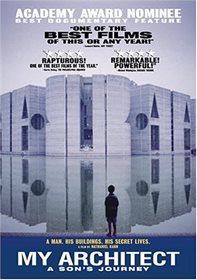
My Architect
Himself (archive footage)
My Architect
Himself (archive footage)


