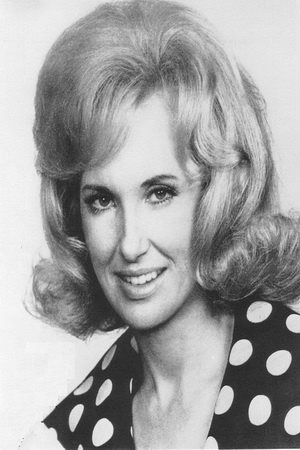
Tammy Wynette
Biography
Virginia Wynette Pugh, known professionally as Tammy Wynette (May 5, 1942–April 6, 1998), was an American country music singer-songwriter and one of country music's best-known artists and biggest-selling female vocalists. She was known as the "First Lady of Country Music" and one of her best-known songs, "Stand by Your Man," was one of the biggest selling hit singles by a woman in the history of the country music genre. Many of Tammy Wynette's hits dealt with classic themes of loneliness, divorce and the difficulties of male-female relationships. During the late 1960s and early 1970s, she dominated the country charts, scoring 17 number one hits. Along with Loretta Lynn and Dolly Parton she defined the role of female country vocalists in the 1970s. Her 1969 marriage to country singer George Jones (which would end in divorce in 1975) created country music's "first couple." The pair recorded a series of duet albums and singles, which charted throughout the 1970s, concurrent to their respective solo hits. Tammy Wynette was born Virginia Wynette Pugh near Tremont, Mississippi, the only child of William Hollice Pugh (died February 13, 1943) and Mildred Faye Russell (1922 – 1991). She was always called Wynette (pronounced Win-net), or Nettie, instead of Virginia. Her father was a farmer and local musician. He died of a brain tumor when Wynette was nine months of age. Her mother worked in an office, as a substitute school teacher, as well as on the family farm. After the death of Hollice Pugh, she left Wynette in the care of her grand parents, Thomas Chester and Flora A. Russell, and moved to Memphis to work in a World War II defense plant. In 1946, she married Foy Lee, a farmer from Mississippi. Wynette was raised on the Itawamba County farm of her maternal grandparents where she was born. The place was partly on the border with Alabama. She often claimed that the state line ran right through their property, joking "my top half came from Alabama and my bottom half came from Mississippi". As a youngster, she worked in the fields picking cotton alongside the hired crews to get in the crop. She grew up with her aunt, Carolyn Russell, who was only five years older than she was. As a child, Wynette taught herself to play a variety of instruments left behind by her father. [1] Wynette also sang Gospel music with her grandmother, a genre Wynette grew to liking, idolizing certain Gospel vocalists like '40s Gospel/Country star, Molly O' Day. As a child and teenager, she found in country music an escape from her hard life. Wynette grew up idolizing Hank Williams, Skeeter Davis, Patsy Cline, and George Jones, and would play their records over and over on the children's record player she owned, dreaming of one day being a star herself. She attended Tremont High School, where she was an all-star basketball player. A month before graduation, she married her first husband, Euple Byrd. He was a construction worker, but had trouble holding down a job, and they moved several times. One of their homes had no running water. She worked as a waitress, receptionist, and a barmaid, and also worked in a shoe factory. In 1963, she attended beauty school in Tupelo, Mississippi, and became a hairdresser; she would renew her cosmetology license every year for the rest of her life, just in case she should have to go back to a daily job. She left her first husband before the birth of their third daughter. He did not support her ambition to become a country singer, and, according to Wynette, told her "Dream on, Baby." Her baby developed spinal meningitis and Wynette tried to make extra money by performing at night. In 1965, Wynette sang on the Country Boy Eddie Show on WBRC-TV in Birmingham, Alabama, which led to some appearances with Porter Wagoner. In 1966, she moved with her three girls from Birmingham to Nashville, Tennessee, where she attempted to get a recording contract. After being turned down repeatedly by every other record company she'd met with, she auditioned for producer Billy Sherrill. Sherrill, who was originally reluctant to sign her, decided to do so after finding himself in need of a singer to cover "Apartment No. 9". When Sherrill heard Wynette sing it, he was impressed and decided to sign her to Epic Records in 1966.