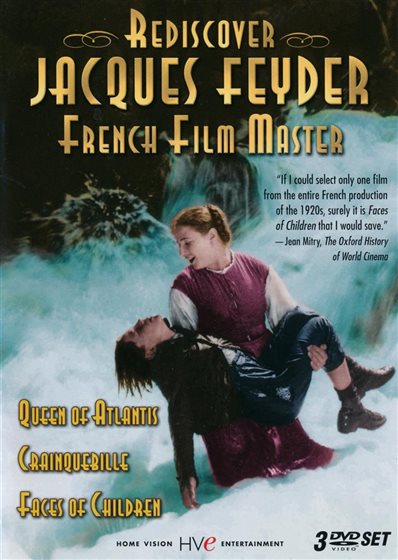
Rediscover Jacques Feyder
5h 57m · 10/24/2006
Description
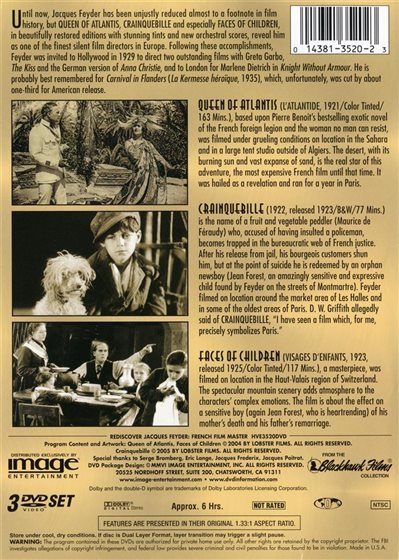
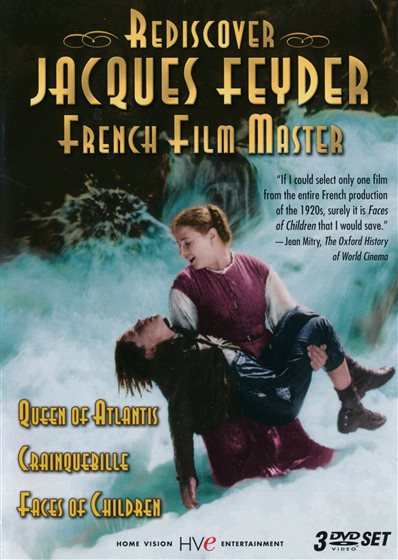
Until now, Jacques Feyder has been unjustly reduced to almost a footnote in film history, but QUEEN OF ATLANTIS, CRAINQUEBILLE and especially FACES OF CHILDREN, in beautifully restored editions with stunning tints and new orchestral scored, reveal him as one of the finest silent film directors in Europe. Following these accomplishments, Feyder was invited to Hollywood in 1929 to direct two outstanding films with Greta Garbo, 'The Kiss' and the German version of 'Anna Christie,' and to London for Marlene Dietrich in 'Knight Without Armour.' He is probably best remembered for 'Carnival In Flanders' ('La Kermesse héroïque,' 1935), which, unfortunately, was cut by about one-third for American release. QUEEN OF ATLANTIS (L'ATLANTIDE, 1921 / Color Tinted / 163 Mins.), based upon Pierre Benoit's bestselling exotic novel of the French foreign legion and the woman no man can resist was filmed under grueling conditions on location in the Sahara and in a large tent studio outside of Algiers. the desert, with its burning sun and vast expanse of sand, is the real star of this adventure, the most expensive French film until that time. It was hailed as a revolution and ran for a year in Paris. CRAINQUEBILLE (1922, released 1923, / B&W / 77 Mins.) is the name of a fruit and vegetable peddler (Maurice de Feraudy) who, accused of having insulted a policeman, becomes trapped in a web of French justice. After his release from jail, his bourgeois customers shun him, but at the point of suicide he is redeemed by an orphan newsboy (Jean Forest, an amazingly sensitive and expressive child found by Feyder on the streets of Montmarte). Feyder filmed on location around the market area of Les Halles and in some of the oldest areas of Paris. D.W. Griffith allegedly said of CRAINQUEBILLE, "I have seen a film which, for me, precisely symbolizes Paris." FACES OF CHILDREN (VISAGES D'ENFANTS, 1923, released 1925 / Color Tinted / 117 Mins.), a masterpiece, was filmed on location in the Haut-Valais region of Switzerland. The spectacular mountain scenery adds atmosphere to the character's complex emotions. The film is about the effect on a sensitive boy (again Jean Forest, who is heartrending) of his mother's death and his father's remarriage.
Release Country
United StatesBarcode
014381352023Release Date
10/24/2006Media Type
MovieDigital Copy
Not IncludedVideo Format
NTSCDiscs

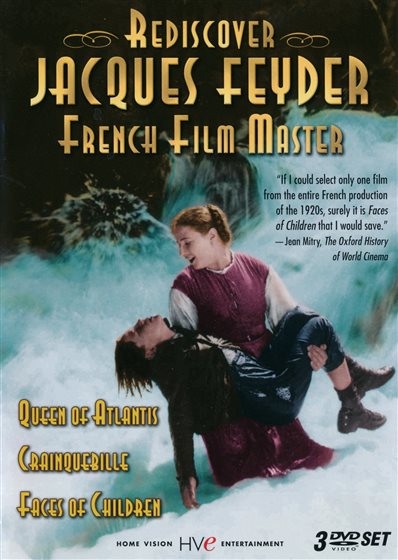
Queen of Atlantis
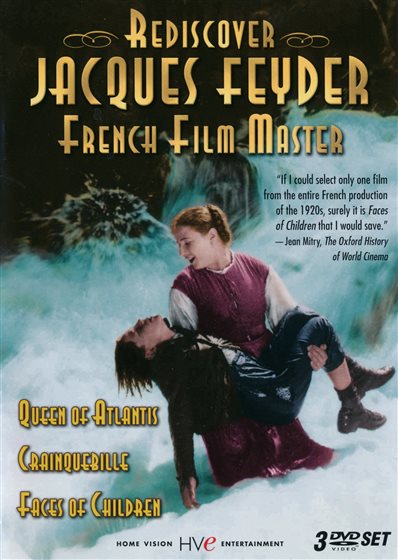
Crainquebille
Faces of Children


